
THREE E-MOBILITY TRENDS EVERYONE NAMES, AND WHAT THEY ACTUALLY MEAN AS THE WHEEL
11th November, 2026
Simon Mandelj, PhD, Founder and CEO, GEM Motors
Most year-end trend articles are written to be agreeable. They name the same three things — electrification, artificial intelligence, sustainability and by February nobody remembers reading them.
The three are not wrong. They are just named without a position attached, so let me attach one.
Sustainability is a consequence of taking things out
Sustainability is not a trend for us. It is the reason the company exists. We did not start GEM Motors to make an incrementally better motor; we started it because moving people and goods through cities deserved a far more efficient way of doing it than the one we had. Everything else we work on follows from that.
In propulsion, sustainability is mostly a question of what you throw away. A conventional drivetrain gives up energy at every mechanical step: transmission, differential, driveshafts, each with its own losses. Put the motor directly in the wheel and those steps disappear, which is how a GEM in-wheel drive holds a system efficiency above 90 percent, typically delivers over 20 percent more range from the same battery, and recovers up to a further 10 percent through regeneration. The cleanest kilowatt-hour is the one the vehicle never has to carry.
That matters more than it sounds. Efficiency at the wheel is what lets a vehicle be built with a smaller battery rather than a bigger one — less lithium, less weight, less cost, less to recycle at the end. And a drive with no gearbox and no driveshafts is a drive with fewer parts to manufacture, fewer to service and fewer to replace. Sustainability in our field is rarely a feature you add. It is usually a consequence of taking something out.
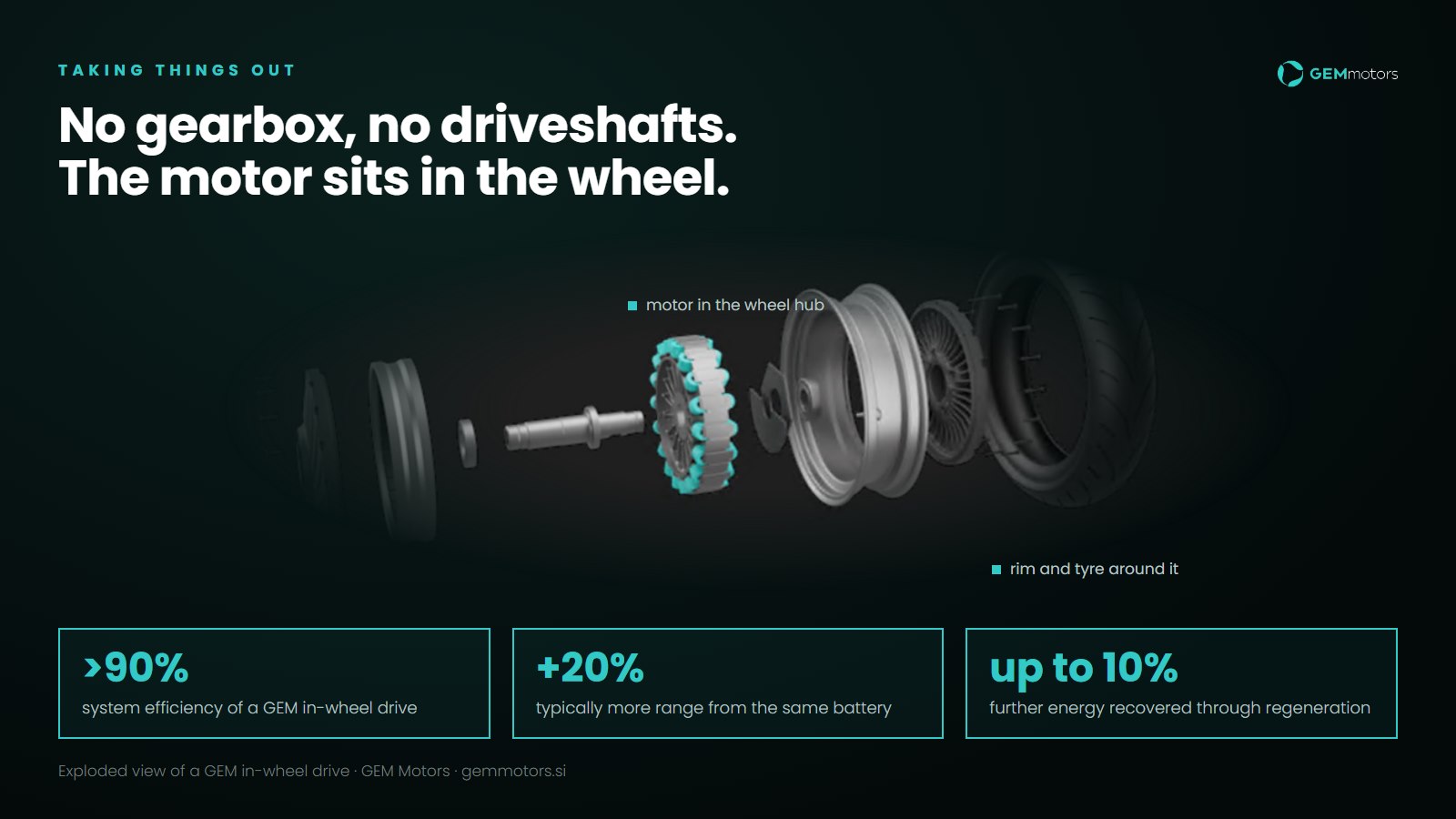
No gearbox, no driveshafts: a GEM in-wheel drive holds a system efficiency above 90 percent.
Electrification is a system, not a component swap
Electrification has stopped being a component swap and become a system. For years it meant replacing a gasoline engine with an electric motor and a tank with a battery. It now means the vehicle, the drive, the control software, the charging infrastructure and the data coming off all of it behaving as one. That is a different engineering problem, and it rewards integration over assembly.
You can see the difference in where the work goes. Swapping a component is a mechanical job. Building a system is an interface job: how the drive talks to the vehicle controller, how torque is arbitrated between wheels, how diagnostics reach the fleet software, how the whole thing behaves when one part degrades. Every interface you remove is a problem you no longer have to solve, so we integrated the motor, the motor controller and the sensors into a single unit inside the wheel, running at low voltage with air cooling and communicating over CAN to whatever sits on it.
The second thing a system rewards is modularity. When propulsion is a self-contained unit rather than a mechanical layout, one platform can carry a cargo bike, a microcar and an inspection robot by changing the motor power level and speed rather than redesigning the vehicle. That is also why electrification of light vehicles keeps moving faster than electrification of cars: there is less legacy architecture in the way.
AI makes the wheel a source of truth
AI capability keeps compounding on the exponential curve computing has followed since Moore’s law was first described. For us the interesting part is not the models themselves. It is that perception and decision-making have become cheap enough to put on a small vehicle that has no driver, which is precisely why robots now sit in an order book we built for scooters and cargo bikes.
What that shift does to propulsion is easy to miss. An autonomous system produces a plan many times a second, and the plan is only ever as good as the hardware executing it. Four independently driven wheels can distribute torque in real time, in response to what each wheel is actually doing, rather than braking the one that has already lost grip. That is not a performance luxury on a robot. It is the difference between a path that is followed and a path that is merely intended.
The traffic also runs the other way. Because the sensors sit inside the wheel as part of the drive, the propulsion system is a source of data as well as a consumer of commands — wheel-level feedback that an autonomy stack or a fleet platform can use for traction, for anomaly detection and for condition-based maintenance, without separate sensors or additional wiring. As the software above gets cheaper and more capable, the value moves to the hardware that can tell it the truth about what is happening on the ground.
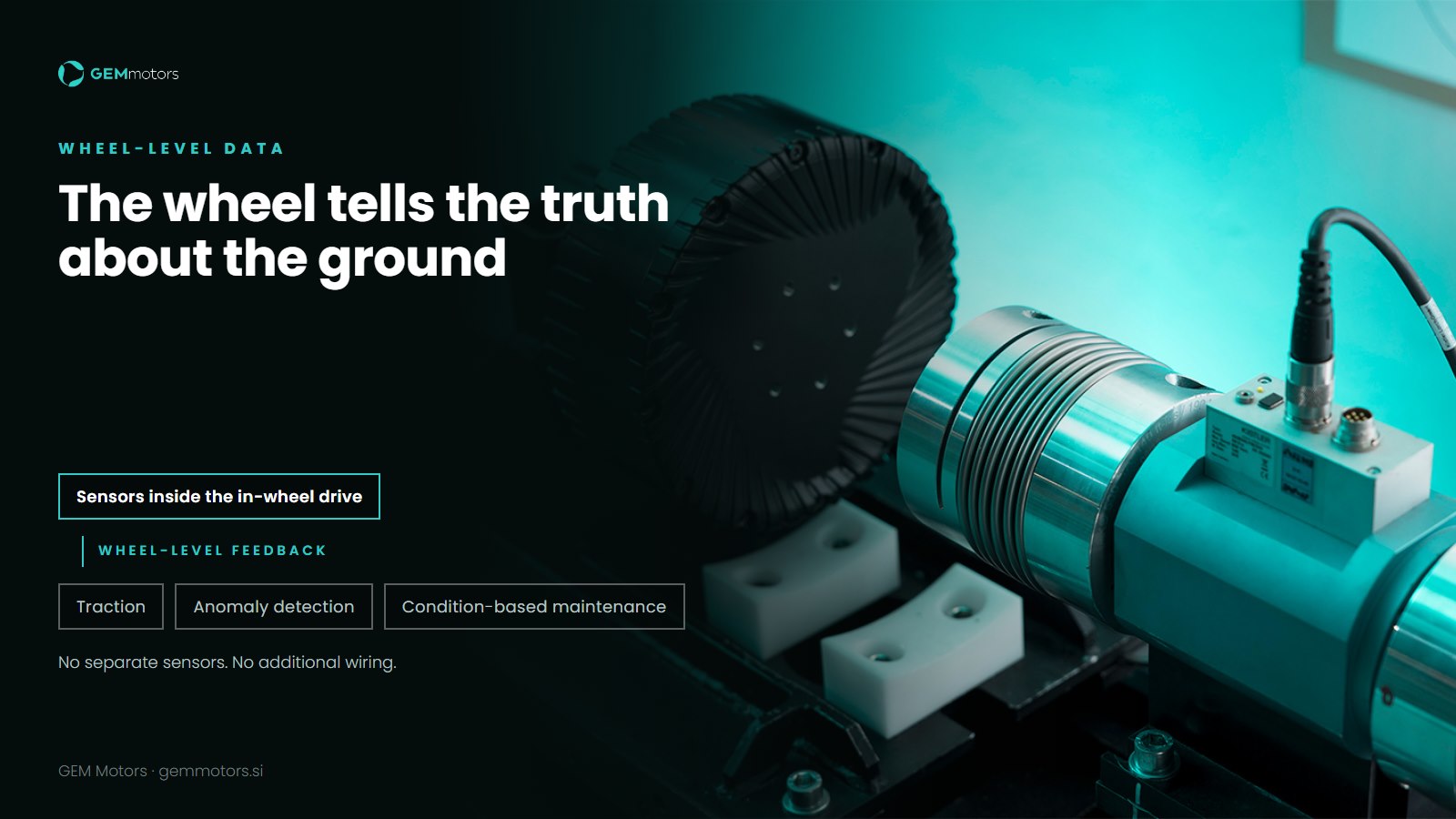
Sensors inside the wheel turn the drive into a source of data for traction, anomaly detection and maintenance.
What the three add up to
Put those three together and you get the shift we have actually lived through this year. Sustainability sets the target of moving a given load with the least energy, which favours light vehicles over heavy ones. Electrification as a system favours propulsion that is integrated rather than bolted together. And affordable autonomy means more of those light vehicles have no driver at all, which turns runtime, manoeuvrability and documentation into the properties that decide a sale.
That is the position. What it looked like in practice is a different story — including a shift in our own customers that we did not see coming. In the companion piece, What surprised us in 2026, and three e-mobility predictions for 2027 specific enough to be wrong, I describe that shift and put three predictions on the record.
FAQ
- What are the main e-mobility trends for 2027?
Sustainability, electrification and artificial intelligence remain the three big ones. Seen from the drive, they translate into three concrete requirements: moving a given load with the least energy, propulsion that is integrated rather than bolted together, and hardware that light autonomous vehicles can rely on. - How does an in-wheel motor make an electric vehicle more efficient?
An in-wheel motor drives the wheel directly, so the transmission, differential and driveshafts — and the losses at each of those steps — disappear. A GEM in-wheel drive holds a system efficiency above 90 percent, typically delivers over 20 percent more range from the same battery, and recovers up to a further 10 percent through regeneration. - Why does a more efficient drive make a vehicle more sustainable?
Higher efficiency at the wheel lets a vehicle be built with a smaller battery: less lithium, less weight, less cost and less to recycle. A drive without a gearbox or driveshafts also has fewer parts to manufacture, service and replace. - What does it mean that electrification has become a system?
Electrification is no longer just swapping an engine for a motor. The vehicle, the drive, the control software, the charging infrastructure and the data must work as one, which makes it an interface problem. GEM integrates the motor, motor controller and sensors into a single low-voltage, air-cooled unit in the wheel that communicates over CAN. - Why are in-wheel motors a good fit for robots and autonomous vehicles?
Four independently driven wheels can distribute torque in real time based on what each wheel is actually doing, so the vehicle follows the path its autonomy system plans. Sensors inside the wheel also supply wheel-level data for traction, anomaly detection and condition-based maintenance, without extra sensors or wiring. - Which vehicles can use a GEM in-wheel drive?
GEM Motors builds electric propulsion for small and light vehicles: bikes, scooters, motorcycles, cargo vehicles and microcars, and increasingly unmanned ground vehicles, automated guided vehicles and inspection robots. The same platform is adapted by changing the motor power level and speed rather than redesigning the vehicle.