
What the EU Machinery Regulation 2023/1230 Requires from Producers of Autonomous Mobile Robots (AGV or UGV)
15th October, 2026
We supply in-wheel drives to robotics companies, which means a growing share of our work ends up inside someone else’s technical file. That is how this information first reached us: not through a regulatory newsletter, but through customers asking what we could document, and how quickly.
Regulation (EU) 2023/1230, the Machinery Regulation, applies from 20 January 2027, replacing Machinery Directive 2006/42/EC. There is no grace period for machinery newly placed on the EU market from that date.
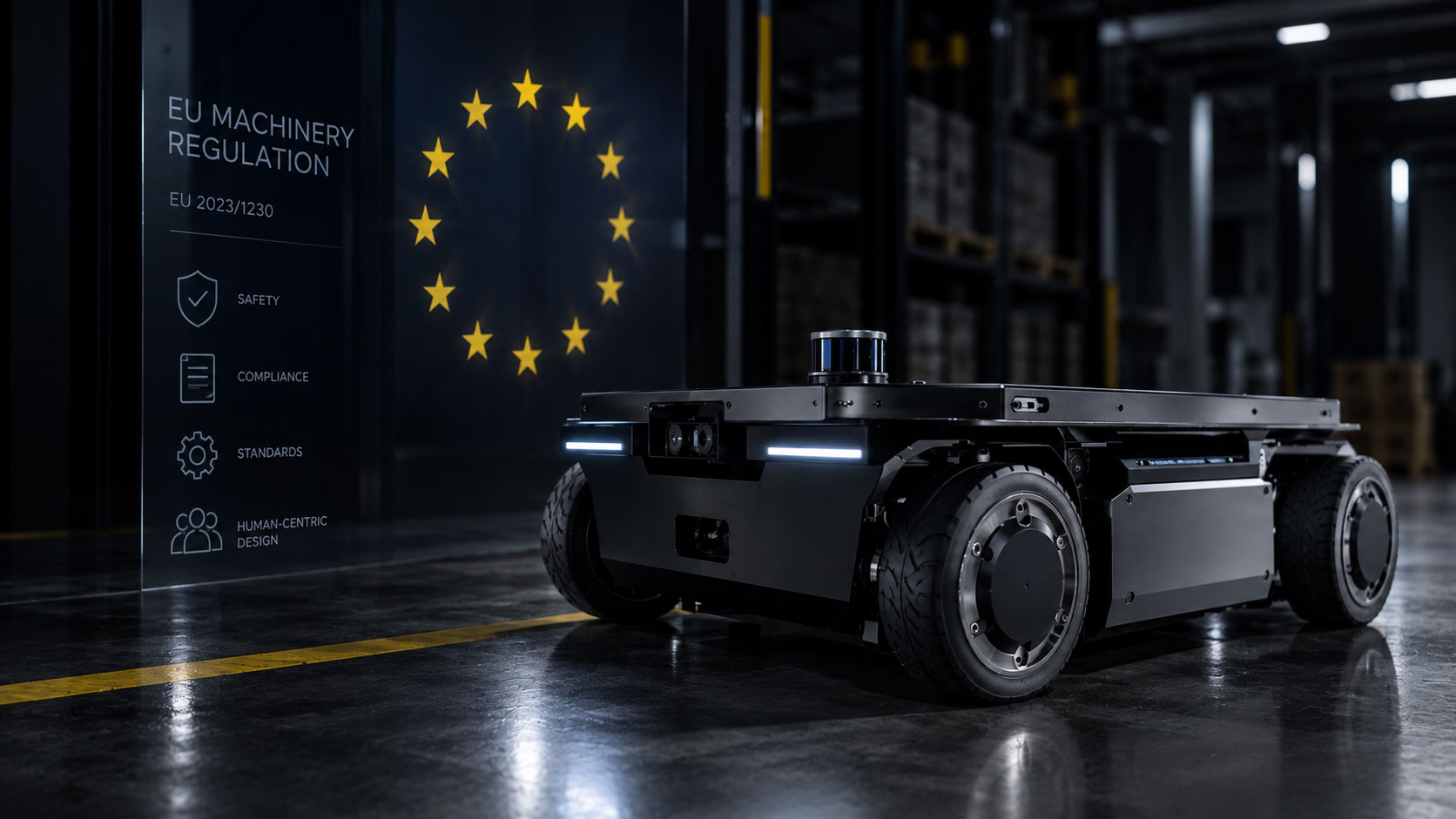
It was written for autonomous machines
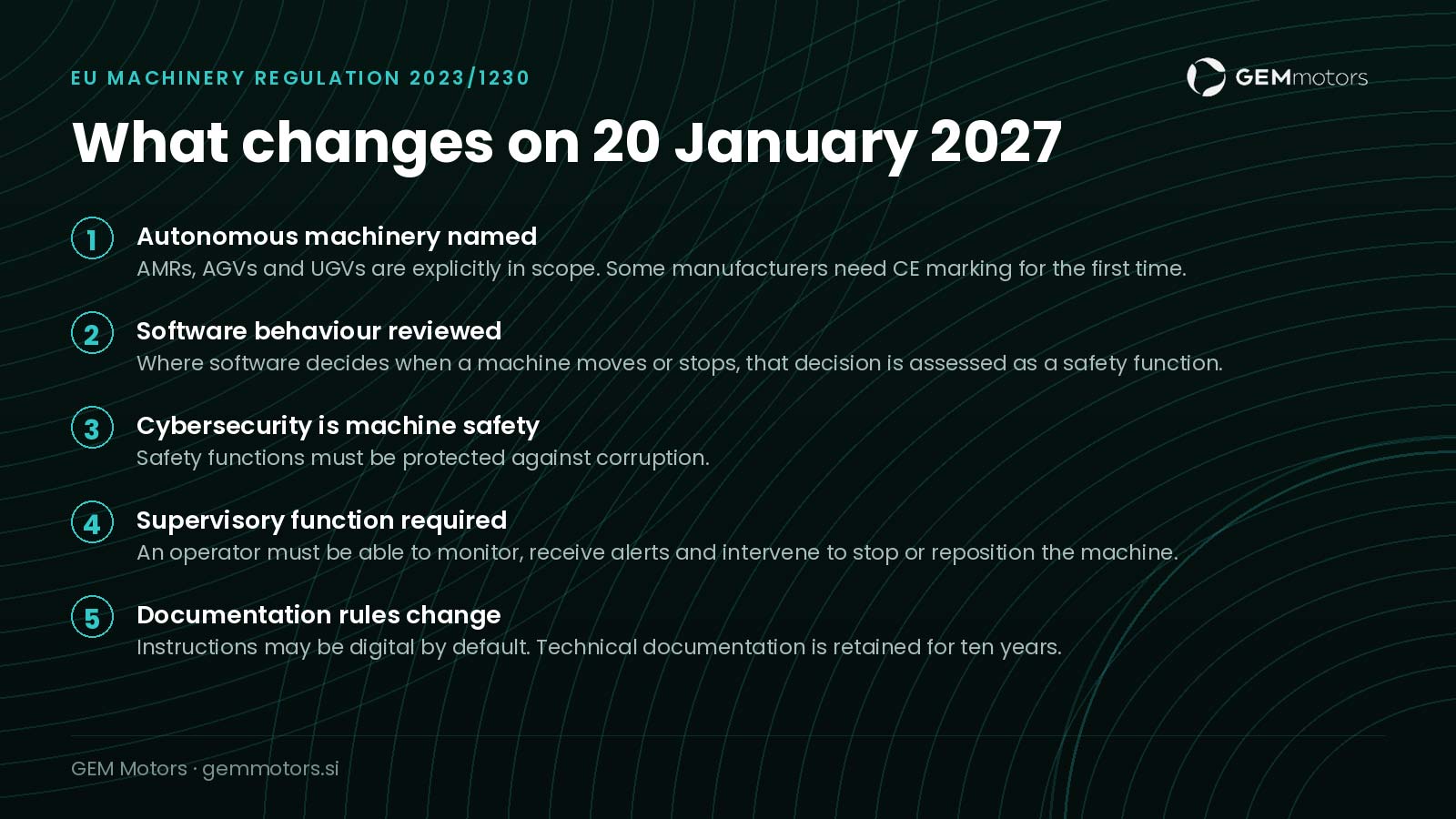
The 2006 Directive predates autonomous mobile robots, including AMR (Autonomous Mobile Robot), AGV (Automated Guided Vehicle) and UGV (Unmanned Ground Vehicle), as well as connected equipment and machine learning in safety functions. The Regulation closes that gap in five ways that matter to anyone building ground robots.
It names autonomous mobile machinery, so AMRs, AGVs, UGVs and robots with autonomous navigation or remote operation are in scope, and some manufacturers will need CE marking for the first time. Where software decides when a machine moves or stops, that behaviour needs safety review. Safety functions must be protected against corruption. Autonomous machines need a supervisory function, so an operator can monitor, receive alerts and intervene — a design requirement, not paperwork. And instructions may be digital by default, with documentation retained for ten years.
Because it is a Regulation rather than a Directive, it applies directly in every Member State, with no national transposition and no variation between markets.
The duty falls on whoever ships the machine
Here is the provision that should change how you buy components: the conformity duty falls on the party who places the final machine on the EU market. Build a platform from a chassis, a drive, a battery, sensors and an autonomy stack from five suppliers, sell it in Europe, and that duty is yours. It does not distribute itself across the supply chain.
This applies wherever you manufacture. If a machine is placed on the EU market, the Regulation governs it, whether it was built in Slovenia, Shenzhen or Detroit. For manufacturers outside the EU, the duty runs through the importer or the authorised representative, both of which now carry explicit obligations of their own. Selling into Europe from abroad does not move the deadline.
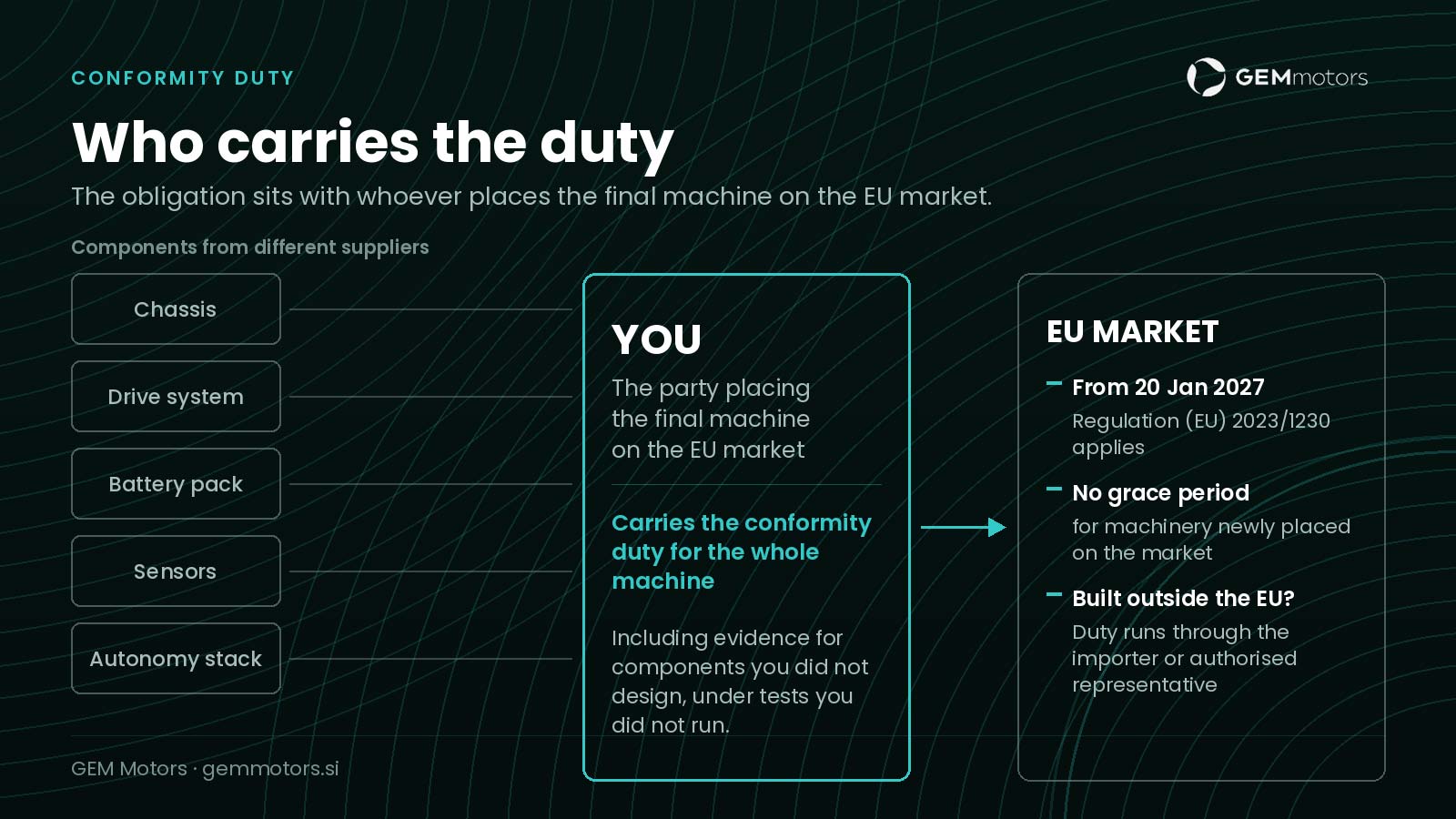
So you will need to evidence components you did not design, under tests you did not run, in a file you are legally responsible for. If a supplier cannot give you that evidence, you can test it yourself, replace the component, or carry the risk.
Ask suppliers what they can document, and how fast
The question vehicle manufacturers ask is not “are you compliant”, since a component alone is usually not the regulated product, but “what can you give me for my technical file, and how quickly”.
For a drive system, ask for external test evidence on ingress protection, salt spray, vibration, temperature shock, EMC and safety isolation. Then ask how it connects to your control architecture. When the motor, controller and sensors sit in the wheel and talk to your autonomy stack over CAN through a vehicle control unit, propulsion is a clean boundary in your design. A drive assembled from separate parts and your own wiring is a boundary you must define and defend yourself.
Our own drives have been through that testing, described here, and our quality system is certified by SIQ under IQNet. None of it was done in anticipation of the Regulation, but because our customers work on airport runways in real weather. The effect is the same: when someone asks what we can document, the answer already exists.
Certification history decides who ships in January
It is tempting to treat this as an administrative cost. I think it is a filter. Everyone selling into Europe faces the same date. Those who clear it will be the ones whose suppliers had already done the testing. Those who do not will spend the first quarter of 2027 unable to place a finished product on their home market, which is more expensive than any certificate.
If you want to know what we can document for the in-wheel propulsion system, get in touch. We will be happy to support you.
FAQ
- When does the EU Machinery Regulation 2023/1230 apply?
From 20 January 2027, replacing Machinery Directive 2006/42/EC. There is no grace period for machinery newly placed on the EU market from that date. Machinery placed on the market before then falls under the 2006 Directive. - Does it cover autonomous mobile robots?
Yes. Autonomous mobile robots, AGVs, AMRs, robots with autonomous navigation and machinery with remote operation features are in scope, as are AI systems performing safety functions. - Who is responsible when a robot is built from third-party components?
Whoever places the final machine on the EU market, normally the integrator — even when the components came from third parties. Importers and authorised representatives carry explicit duties of their own. - Does the Regulation apply to machines manufactured outside the EU?
Yes. What matters is where the machine is placed on the market, not where it was built. For non-EU manufacturers, the obligations run through the importer or the authorised representative in the EU. - What certification evidence should I request from a drive supplier?
External test evidence for ingress protection, salt spray, vibration, temperature shock, EMC and safety isolation, plus documentation of the communication interface to your control architecture.