
AUTONOMY STARTS AT THE WHEEL
22th September, 2026
Autonomous robots have learned to see and decide; how well they move now depends on the electric drive.
More and more companies come to us developing autonomous and robotic platforms that can already see, plan and decide, and are missing only one thing: something to move them that is simple to integrated, efficient and with advanced integrated technology. It is a different conversation from the ones we had when I founded GEM Motors in 2010, but the problem underneath is the same: electric propulsion for small and light vehicles, done properly. What has changed is how much now depends on it.
The pilot phase is over
Ask anyone outside our industry what makes a vehicle autonomous and you will hear about cameras, LiDAR and artificial intelligence. Five years ago that answer was complete. Today it is half of the picture. Perception has matured and standardised; propulsion has not, and it is now what decides whether a robotic platform reaches production or stops at prototype.
This is no longer a forecast. Starship Technologies passed ten million autonomous deliveries in April 2026, operating more than 3,000 robots across more than 300 locations in eight countries, most of them European. In Finland, roughly one in five grocery deliveries is now completed by a robot. Mordor Intelligence forecasts the autonomous delivery robot market growing from USD 1.33 billion in 2026 to USD 3.27 billion by 2031, and Wood Mackenzie expects autonomous electric vehicles to be operating or under test in 39 markets worldwide by the end of 2026.
That is only the visible half of the market. In Europe, the steadier commercial volume sits in airports, industrial sites, agricultural land and logistics yards, where regulatory friction is lower and the business case is already proven.
The bottleneck moved from perception to propulsion
An autonomous system produces a plan. The vehicle either executes it precisely or it does not.
Conventional drive architecture evolved from gasoline drive — a central motor, transmission, differential and driveshafts — was designed for a person at the wheel at road speed. On a robotic platform it brings mechanical complexity, packaging constraints, energy losses and extra points of failure. Its approach to traction is reactive: it brakes the wheel that is already slipping.
That mismatch shows up as four practical problems. Precision at low speed, because these vehicles work slowly, in confined spaces, often near people. Runtime, because every point of drive efficiency becomes another task completed per charge. Uptime, because fleets earn nothing in a workshop. And certification, because a drive that cannot evidence its behaviour under ingress, vibration, corrosion and EMC testing becomes a liability the moment a technical file is assembled. We described that testing in details.
Independent wheel control changes what a platform can do
Our answer has always been to put the drive as close to the wheel with minimal space required. A GEM in-wheel drive is a direct drive: the electric motor, the motor controller and the sensors are integrated in the wheel as a single unit, built on GEM Motors’ patented modular multiphase technology. There is no transmission and no differential; mechanical coordination is replaced by control based on precision position sensor. Where the torque is produced, matters.
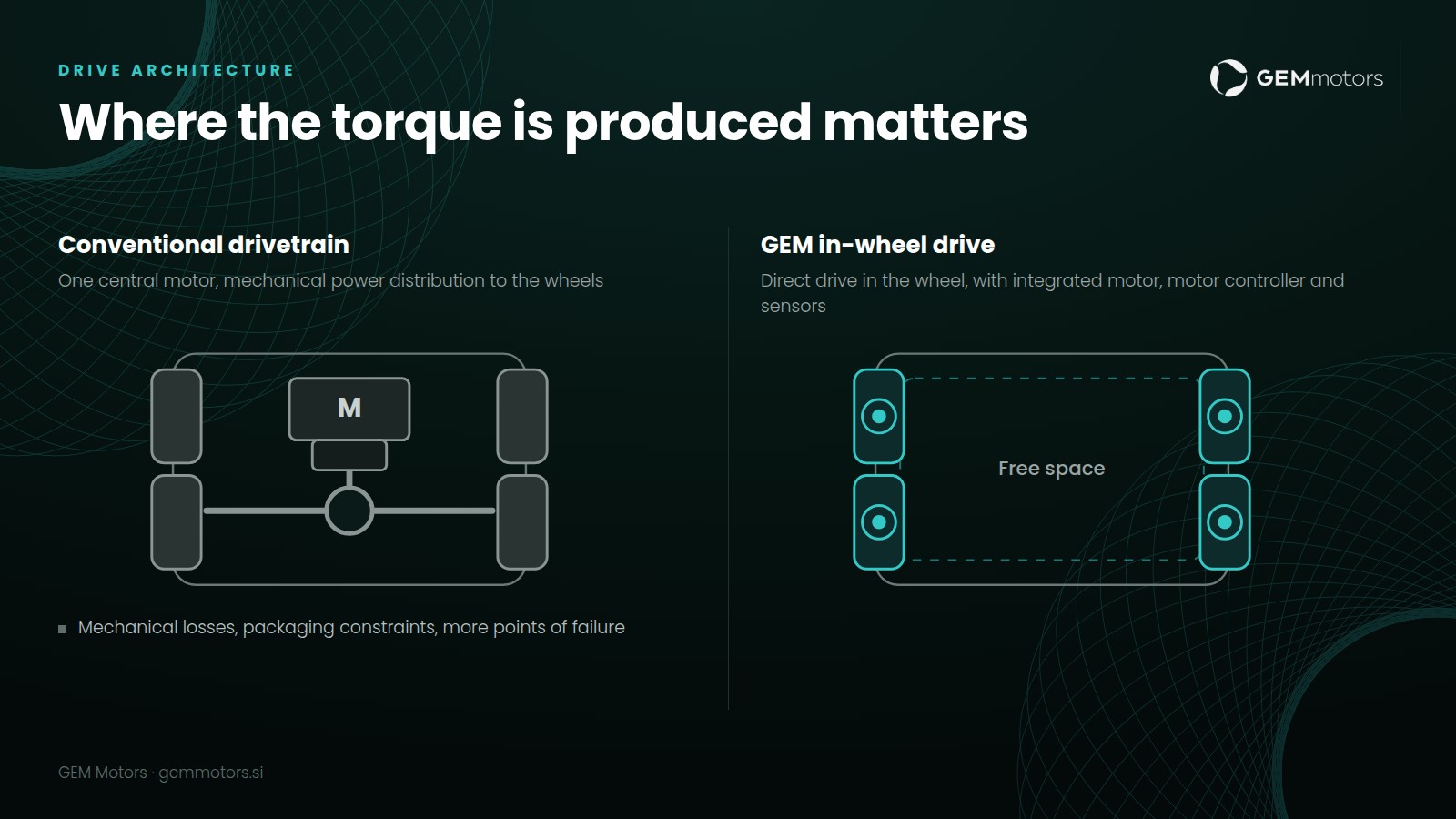
Each wheel is driven independently and in full synchronization, so torque is distributed in real time rather than taken away from a wheel that has already lost grip. That is more than simulating a limited-slip differential. It is traction behaviour a mechanical drivetrain cannot produce.
Eliminating transmission inefficiencies and reducing controller losses allows a GEM in-wheel drive to maintain system efficiencies of over 90 percent and typically increases vehicle range by over 20 percent compared with conventional drivetrains. For an autonomous robot, range is runtime.
For an autonomous platform, the sensing matters as much as the motor. Because motor sensors are already in the wheel as part of the drive, wheel-level data reaches the GEM VCU and the autonomous system over CAN without separate sensors, extra wiring or additional integration work. The platform developer gets propulsion, control and wheel sensing as one package rather than assembling them from different suppliers.
With nothing between the wheels, the whole chassis is free for batteries, payload and sensors. That is why the same drive family appears across quite different vehicles in our portfolio, from cargo bikes to unmanned ground vehicles.
The standard objection is fair: mass inside the wheel increases unsprung mass. In a passenger car at highway speed that is a real trade-off. On an autonomous platform working at walking pace, where the measure is operating hours rather than ride comfort, the unsprung mass penalty is largely irrelevant.
From concept to European airports
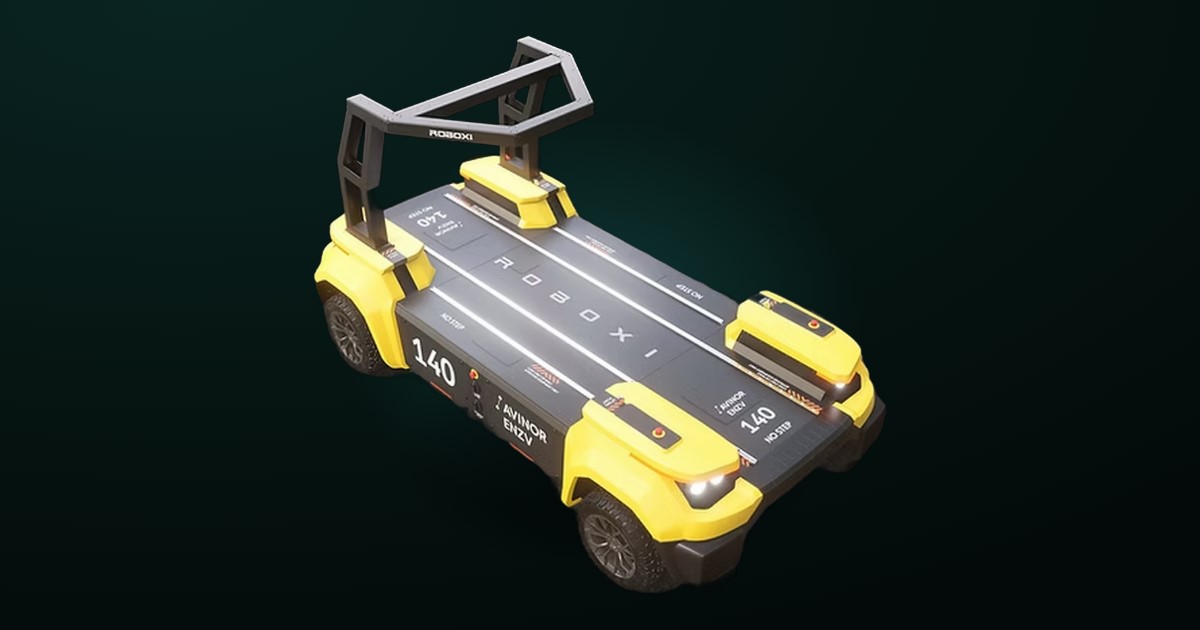
Velo Robotics and Roboxi needed propulsion for a fully electric robotic platform for airport and industrial work, operating in snow, ice, dust and wind. The platform runs in both autonomous and remote-controlled modes, which is how most ground robots at this stage of the market operate.
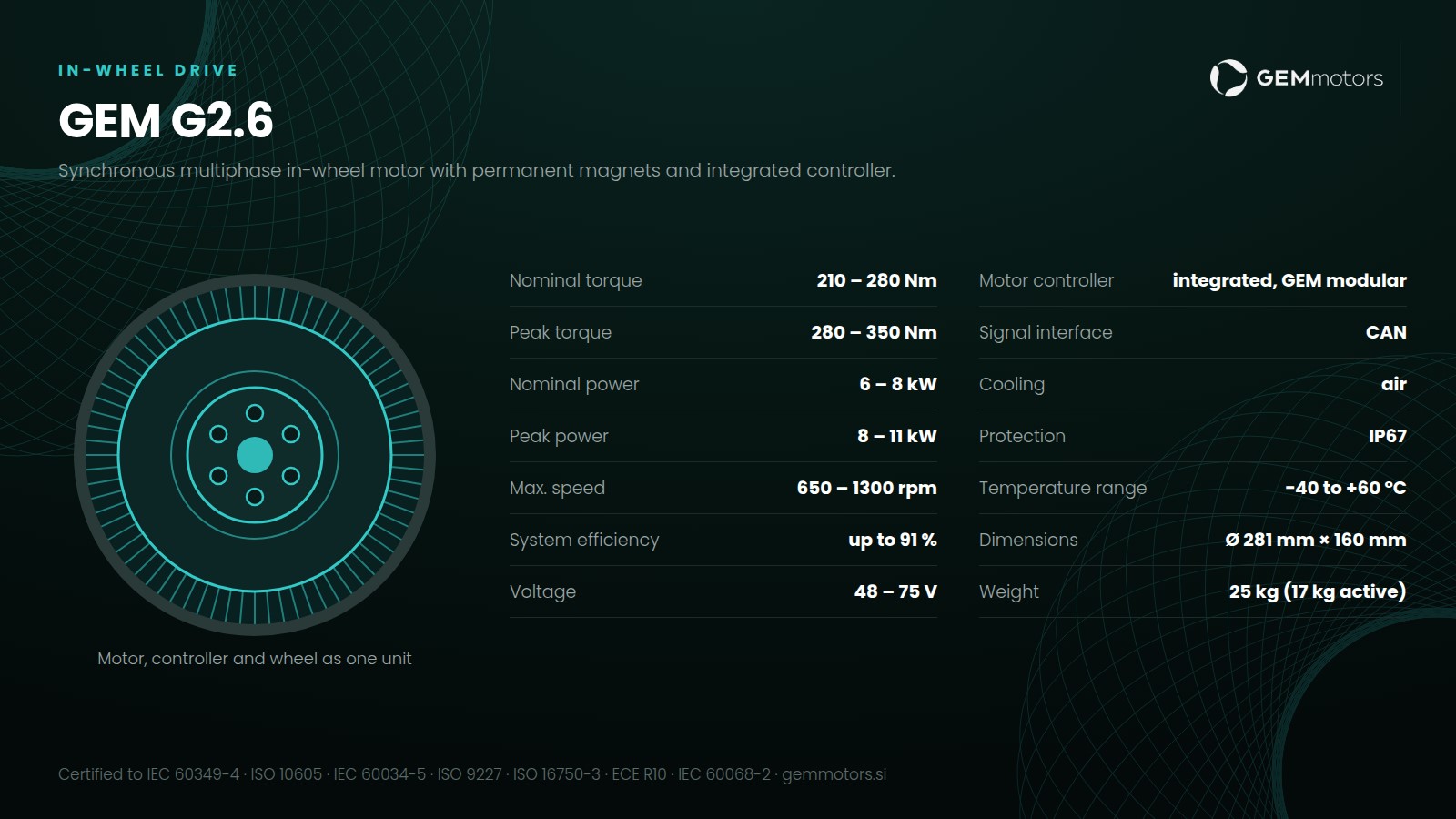
They selected GEM Motors’ integrated 4WD in-wheel drive system, with one GEM G2.6 in-wheel drive per wheel. In the Roboxi configuration, each drive delivers up to 280 Nm of torque and 9 kW of power. The drives are transmission-free, sealed to IP67 and air-cooled, with the motor controller integrated inside the wheel, and a GEM VCU coordinates real-time torque distribution with the autonomous system over CAN.
The full G2.6 specification, which covers a wider range of configurations, is shown below.
Whichever mode it runs in, the propulsion requirement is the same. Two results are worth reporting. Independent wheel control gave the platform the manoeuvrability, traction and stability it needed across varying terrain. And using a validated e-drive shortened the path from concept to operational prototype: production has begun, and the platform is in service at multiple airports across Europe.
Propulsion development is not where a robotics company’s competitive advantage lies, but it is entirely capable of consuming a year of it.
Autonomy begins at the core
Autonomous light electric vehicles are a useful part of the mobility picture. They move goods at a fraction of the energy of a van, and they are small enough to fit a city rather than dominate it.
But autonomy does not begin with software. It begins at the core, with the electric drive solution. The platforms now reaching commercial scale are winning on manoeuvrability, runtime, durability and time to market. Every one of those is decided at the wheel.
If you are building an autonomous platform and want to discuss propulsion, our engineering team is available for that conversation.
FAQ
- Why are in-wheel motors used in autonomous robots
Autonomous platforms need precise manoeuvring at low speed, high energy efficiency for longer runtime between charges, and durability in outdoor conditions. Independent wheel control allows torque to be distributed to each wheel in real time, which improves traction, stability and manoeuvrability in confined or dynamic environments. Easy and simple drive integration to the vehicle. - Does the unsprung mass of an in-wheel motor matter on a robot?
Much less than on a passenger car. Unsprung mass mainly affects ride quality and suspension behaviour at road speed. Autonomous light electric vehicles typically operate at very low speed, where operating hours and traction matter more than ride comfort. - How does a GEM in-wheel drive connect to an autonomous control system?
Through the GEM VCU, a vehicle control unit that manages real-time torque distribution and communicates with the autonomous system over CAN. Because the motor, the motor controller and the sensors are integrated in the wheel, the drive delivers propulsion, control and wheel-level sensing as one package with a single defined interface to the autonomy stack. - Which robotic vehicles use GEM in-wheel drives?
GEM in-wheel drives are used in the airport and industrial platform developed by Velo Robotics with Roboxi, which operates in autonomous and remote-controlled modes and is in service at multiple European airports, and in a six-wheel autonomous off-road platform developed by the Slovenian company RTC.